When planning a large-format LED display project, power consumption is one of the most frequently underestimated variables. Yet it directly determines your electrical infrastructure requirements, ongoing operating costs, and long-term ROI.
How can you calculate LED display power consumption? What are the typical LED display power consumption ranges? What energy-efficient LED displays can you use for your billboard networks or stadium installation? Let’s explore in this guide!
How to Calculate LED Display Power Consumption
Before running any numbers, it is important to understand the difference between two related but distinct concepts: power and energy.
- Power (Watts / kW) is the rate at which electricity is consumed at any given moment — think of it as the speed of water flowing from a tap.
- Energy (kilowatt-hours / kWh) is the total electricity consumed over time — the total volume of water that has flowed through.
The relationship between the two is straightforward:
Energy (kWh) = Power (kW) × Time (hours)
To calculate the power consumption of LED displays accurately for a specific installation, follow these steps:
Step 1 — Find the maximum power per square meter.
Manufacturers publish this figure in their specification sheets, expressed in W/m². It represents the absolute peak draw when the screen displays full-white content at 100% brightness.
Step 2 — Calculate total peak power.
Total Peak Power (W) = Screen Area (m²) × Max Power per m² (W/m²)
Add a safety margin of 10–20% on top when sizing electrical circuits, to account for cable losses and cooling equipment.
Step 3 — Estimate average operating power.
LED displays rarely run at peak. During typical video or mixed-content playback, actual draw is usually 30–60% of the maximum rating.
Average Power (kW) = Total Peak Power (kW) × Load Factor (0.3–0.6)
Step 4 — Calculate daily energy consumption.
Daily Energy (kWh) = Average Power (kW) × Daily Operating Hours
Step 5 — Estimate electricity cost.
Daily Cost = Daily Energy (kWh) × Local Electricity Tariff
One critical point for project planning: the maximum rated power is not the power your screen will actually use day to day. Peak consumption only occurs when every pixel is driven at maximum brightness, displaying a full-white image — conditions that are rare in real-world deployments.
Actual power consumption of LED displays in operation depends heavily on content type, brightness settings, and environmental conditions, all of which are discussed in the next section.
Key Factors Influencing the Power Consumption of LED Displays
Understanding what drives energy use helps you design more efficient installations and set realistic budget expectations.
1. Screen Size
The larger the display, the more LED components it contains and the more power it draws. A 20 m² outdoor video wall will consume dramatically more electricity than a 4 m² retail display under the same pixel pitch and brightness settings.
2. Pixel Pitch
Pixel pitch refers to the center-to-center distance between adjacent pixels. A smaller pitch means more LEDs packed into each square meter. A P1.5 or P2.5 fine-pitch screen draws considerably more power per square meter than a P6 or P10 screen of the same area, because more LEDs are operating simultaneously.
3. Brightness Level
Brightness is one of the single biggest drivers of LED screen power consumption. Higher brightness requires a greater electrical current for each LED.
Outdoor displays typically need 5,000 nits or above to remain legible in direct sunlight, pushing power draw significantly higher than indoor equivalents. Notably, reducing brightness by 20–30% can cut power consumption by 25–40% without a visible drop in image quality for most viewing conditions, such as early evening hours.
4. Content Type
Because LEDs are self-emissive, the content color has a direct impact on power draw. A full-white or very bright image activates all RGB sub-pixels simultaneously, pushing consumption to its peak. Dark or black backgrounds consume very little energy, as the corresponding LEDs are effectively switched off. High-motion video also typically consumes more power than static imagery.
5. Operating Time
Total energy consumption is a direct product of power and time. A screen running 24/7 at high brightness accumulates enormous energy bills. Implementing smart scheduling — auto-dimming at night, standby during off-peak periods, or reducing brightness when footfall is low — can dramatically reduce total operating costs over the asset’s lifetime.
Typical LED Display Power Consumption Reference
The table below outlines the typical power profiles for various display types and technologies.
| Display Type | Application | Common Pixel Pitch | Peak consumption (W/m2) | Avg. consumption (W/m2) |
| Indoor Information | Control Room, conferences, shopping malls, retail | P0.9 – P2.5 | 300 – 600 | 150 – 300 |
| Indoor Decoration | Venues, Shopping malls | P2.5 – P6 | 400 – 650 | 200 – 330 |
| Indoor Rental & Stage | Events, XR filming | P1.9 – P3.9 | 600 – 800 | 300 – 400 |
| Outdoor Community | Community signs, bus station | P2.5 – P6 | 550 – 800 | 280 – 400 |
| Outdoor Architecture | Building facade | P5 – P16 | 550 – 800 | 280 – 400 |
| Outdoor Signage | Highway, rooftop | P13 – P25 | 550 – 850 | 280 – 430 |
| Outdoor Rental & Stage | Events, Concerts | P3.9 – P6 | 550 – 800 | 280 – 400 |
Note: Average consumption reflects realistic mixed-content playback, typically 30–60% of the peak rating. Energy-efficient displays using advanced technologies such as LOB (Lens on Board) or common-cathode circuit design can achieve significantly lower figures. Some energy-optimized outdoor models reach maximum consumption as low as 120 W/m².
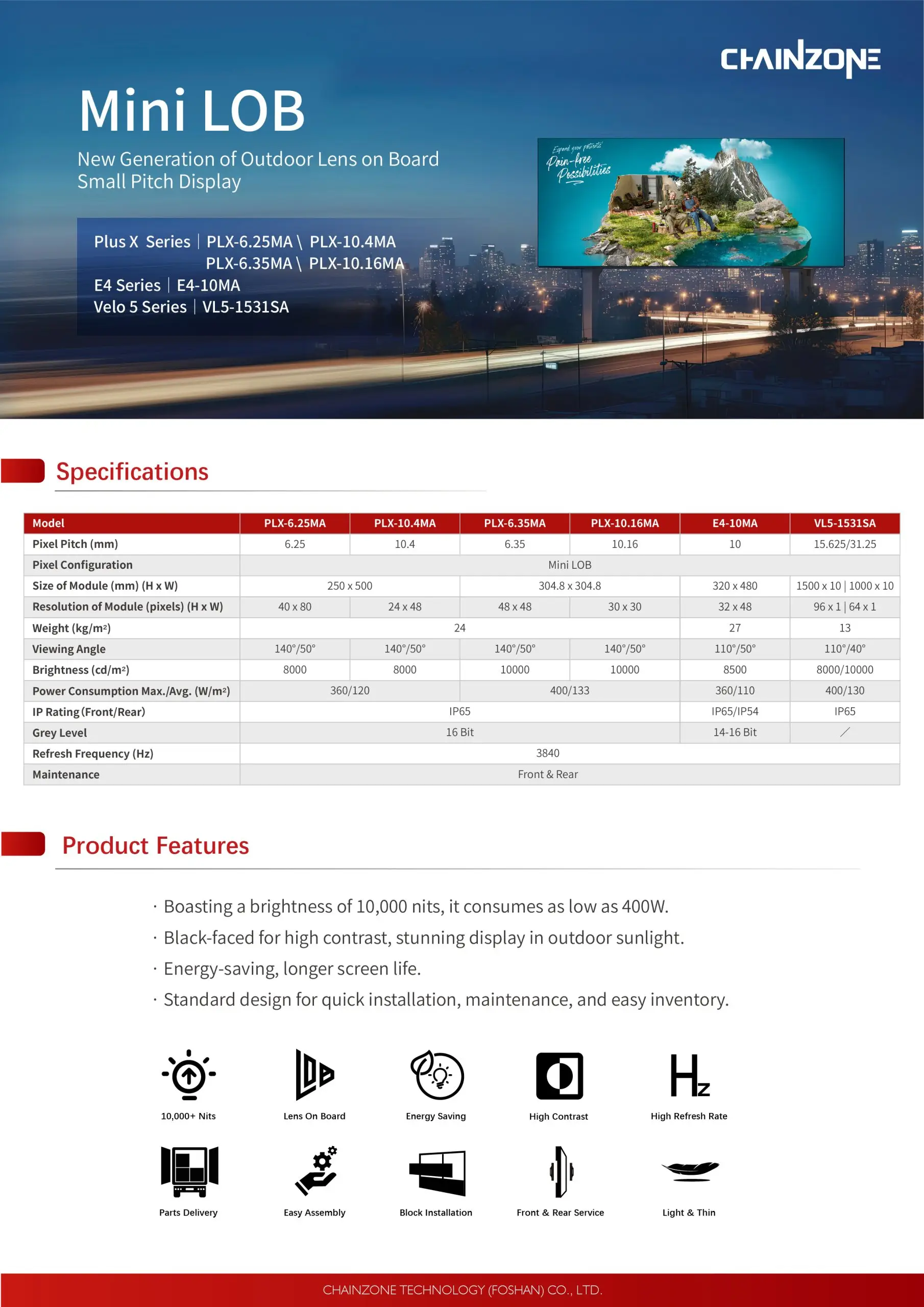
Picture shown: Chainzone Mini LOB LED Display
5 Tips to Reduce LED Display Power Consumption
1. Lower brightness when full intensity is unnecessary
Brightness should match the ambient environment, not be set to maximum as a default. Equipping displays with ambient light sensors for automatic adjustment is one of the highest-impact changes you can make — it reduces both electricity costs and light pollution while extending LED lifespan.
2. Use content with darker backgrounds where appropriate
Content designers should understand that dark-background creatives reduce real-world energy draw significantly. For advertisers or operators who have control over content scheduling, darker, high-contrast designs can lower daily kWh consumption considerably without sacrificing visual impact.
3. Choose energy-efficient LED modules and power supplies
Hardware selection defines the energy ceiling for your installation. Technologies such as miniLOB, microLED, or common-cathode modules deliver superior luminous efficiency — more light output per watt consumed. Equally, invest in high-quality power supplies with conversion efficiencies of 80–90% or higher and power factor correction (PFC) to minimize electrical losses.
4. Match display size and brightness to the actual installation environment
Over-specification is a common and expensive mistake. A large-pitch display is entirely adequate for a site viewed from 20 meters away; deploying a P2 fine-pitch screen in that scenario wastes both capital expenditure and ongoing electricity. Similarly, indoor environments have no need for outdoor-grade brightness levels of 5,000+ nits.
5. Maintain displays regularly to prevent performance degradation
Dust and grime accumulation on display surfaces reduces brightness output, prompting operators to increase brightness settings manually — which in turn increases power draw.
Poor heat dissipation caused by clogged ventilation accelerates LED degradation and raises operating temperatures, both of which reduce energy efficiency over time.
Scheduled cleaning, thermal inspections, and proactive replacement of aging power supply components all help maintain peak efficiency throughout the display’s service life.
Chainzone Offers Energy-Efficient LOB LED Displays
For organizations where long-term operating costs and total cost of ownership are priorities, hardware technology selection makes a decisive difference. Chainzone has developed our proprietary LOB (Lens On Board) technology to directly address the energy and performance challenges of outdoor digital signage.
The LOB technology places an optical lens directly over each LED chip, concentrating the light path and maximizing usable output per watt. The result is a display that delivers exceptional brightness with significantly less electrical input.
Our Plus X Series, built on MiniLOB technology, demonstrates the practical impact of this approach:
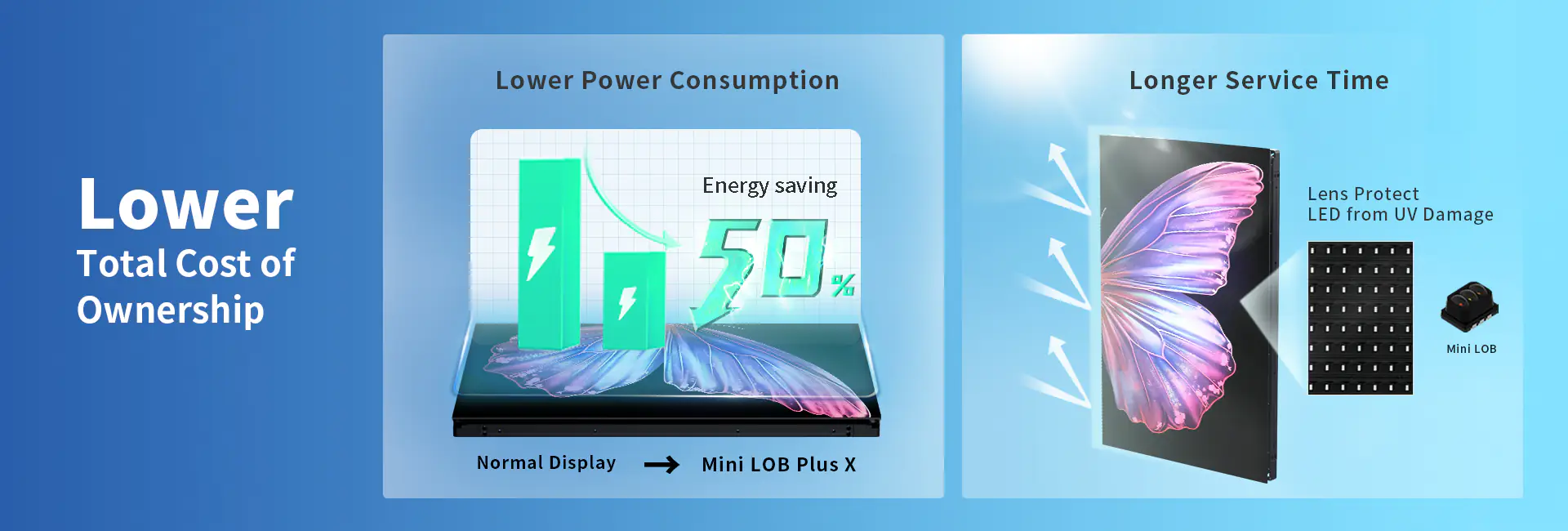
- Up to 50% energy savings compared to conventional outdoor LED displays
- Power consumption as low as 400 W/m² while maintaining 10,000 nits brightness — a performance level that would typically require far greater power draw from standard SMD technology
- IP65-rated weather protection for reliable 24/7 outdoor operation
- 7,680 Hz refresh rate for smooth, flicker-free visuals suited to broadcast and advertising-quality content
- Available ina wide pixel pitch range, such as P6.25, 35, P10.16, P10.4, and P16.6, to match a range of viewing distances and installation types
For a 50m² outdoor billboard, switching to Chainzone’s LOB technology may save tens of thousands of dollars in electricity costs over the display’s lifetime—directly improving your ROI from year one.
Conclusion
Understanding how to calculate LED display power consumption is essential for identifying opportunities to reduce electricity costs. One of the most influential factors is the maximum power consumption, which is determined by the hardware configuration.
Chainzone’s LOB design concentrates the light path, allowing the screen to reach a staggering 10,000 nits of brightness while consuming as little as 400W per square meter at peak load.
In addition to that, with over 25 years of experience, 100+ patents, and installations across 120+ countries—including landmark projects like the Hong Kong-Zhuhai-Macao Bridge—Chainzone can be your reliable partner to offer the right LED display solution.
For more about our offerings, you are more than welcome to reach out to us!