
When evaluating LED displays for commercial or public deployment, technical specifications like pixel pitch and brightness often dominate the conversation. Yet, the display viewing angle — a key factor in how many people can actually see your screen clearly and from which positions — is often underestimated.
What is the viewing angle? How does it impact your audience reach, advertising ROI, and overall user experience? Read on to get it right—otherwise, much of your audience may end up seeing a dim, washed-out image!
What Is the Viewing Angle of an LED Display?
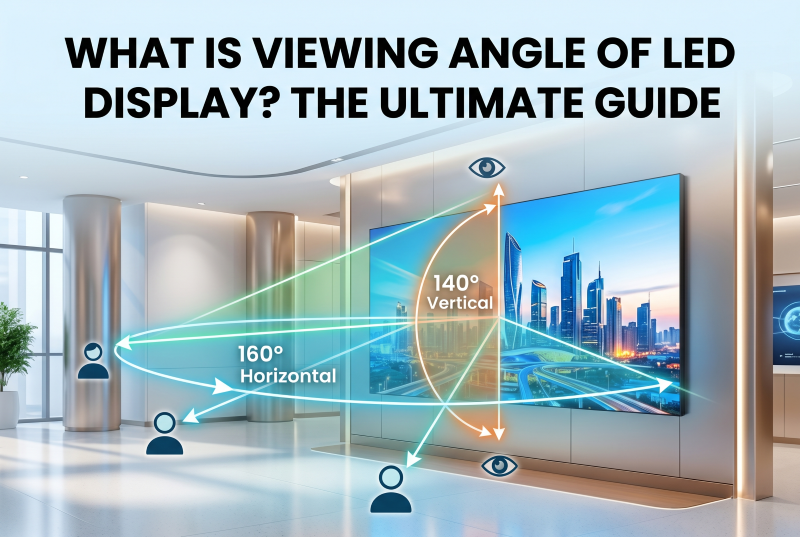
The display viewing angle refers to the maximum angular range from which an audience can view the screen clearly, without significant loss of brightness, color accuracy, or contrast. Once a viewer moves beyond this angular threshold, the image begins to degrade — brightness drops noticeably, colors may shift, and contrast diminishes, resulting in a poor visual experience.
In technical specifications and real-world applications, the LED screen viewing angle is measured along two axes:
- Horizontal viewing angle: The range to the left and right of the screen’s center axis within which the image remains clear and accurate.
- Vertical viewing angle: The range above and below the screen’s center axis within which image quality is maintained.
How to Measure LED Display Viewing Distance
The industry standard definition places the maximum viewing angle at the point where brightness drops to 50% of the peak center luminance — commonly referred to as the “half-brightness angle.” Some stricter standards also use a contrast ratio drop to 10:1 as the cutoff threshold.
What Is a Good Viewing Angle for LED Displays?
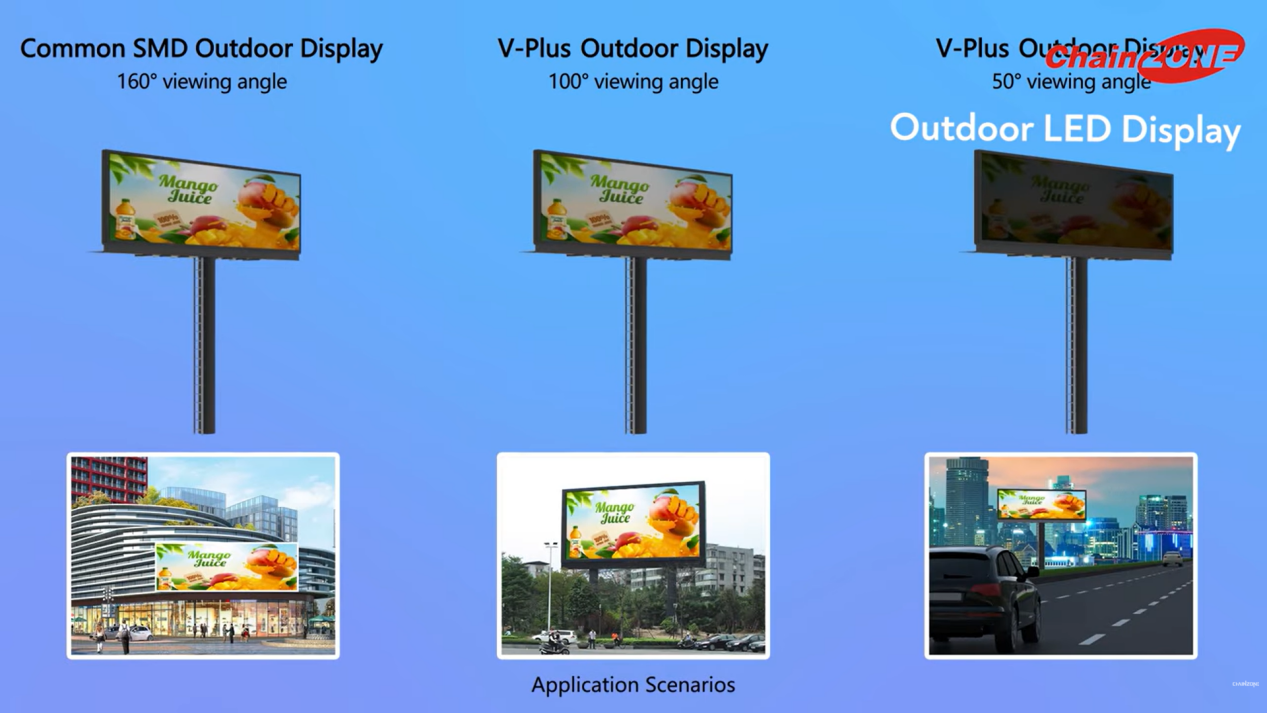
Now you may ask about a good viewing angle—the answer is that there is no universal “good” viewing angle. A “good” display viewing angle is highly context-dependent and varies based on installation environment, application type, and the physical distribution of your audience.
As a general benchmark, commercial LED displays typically offer a horizontal viewing angle ranging from 120° to 160°, while the vertical viewing angle is usually around 70° to 140°. Indoor commercial screens commonly fall in the 100° to 140° range or wider, depending on venue size, while outdoor advertising billboards, large event screens, and sports venues typically benefit from 140° to 160° or more.
One important point for procurement teams: do not default to selecting the largest viewing angle figure on a spec sheet. Optically, an excessively wide viewing angle causes light to spread more broadly, which reduces peak front-facing brightness and contrast. The ideal choice is always the one that best matches your real-world audience positioning — balancing viewing angle, luminance, and contrast for your specific venue layout.
Factors That Affect LED Screen Viewing Angle
Understanding what influences the LED screen viewing angle helps you make more informed decisions when comparing products.
1. LED Packaging Technology
Packaging fundamentally determines light dispersion characteristics:
- DIP (Dual In-line Package): Traditional through-hole technology produces focused, directional light with relatively narrow angles of 100°–110°. Suitable for targeted viewing scenarios.
- SMD (Surface-Mounted Device): Mainstream technology where RGB chips mount on the same surface, achieving 120°–140° with uniform color.
- COB (Chip-on-Board): Chips directly encapsulated on PCB without lamp housings, enabling 160°+ ultra-wide angles with minimal blind spots.
2. LED Size and Shape
The physical dimensions and geometry of LED components directly affect how light scatters. Larger LEDs generally feature bigger lens surfaces that disperse light across wider angles.
Additionally, some applications use specific shapes—elliptical LEDs, commonly used in outdoor displays, often have asymmetric viewing angles (e.g., 100° horizontal, 50° vertical) to focus light in a specific zone.
3. Coatings, Optics, and Surface Treatments
Optical lenses, reflectors, and diffusers are used to control light direction with precision. Anti-glare coatings, optical films, and angle-optimizing layers on the screen surface reduce reflections from ambient light and can reshape the viewing cone itself.
Further, the refractive properties of encapsulant materials — such as silicone or epoxy — used to seal LEDs also influence how light disperses at the output stage.
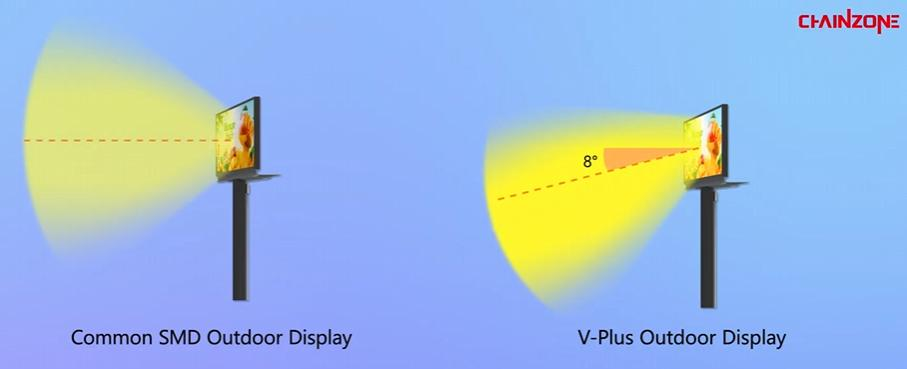
One important example is Chainzone’s LOB (Lens on Board) technology. Supporting wide viewing angles, it uses lenses to refract and control the light inside the light guide rod, making it more focused on the targeted audience. For instance, at intersections, the lens reduces upward light emission and redirects the viewing focus toward a downward angle, where it is more effective.
4. Brightness and Contrast Performance
There is an inherent physical trade-off between viewing angle and luminance. Wider viewing angles mean light is dispersed over a larger area, which reduces peak front-facing brightness. Narrower angles concentrate light forward, maximizing peak luminance.
High-quality screen design finds the optimal balance: delivering sufficient on-axis brightness while maintaining acceptable contrast and color fidelity at the rated off-axis angles.
A screen with poor contrast management may appear washed-out or grey when viewed from the sides, even within the specified angle range.
5. Screen Installation Height and Angle
This is the application factor that determines required vs. wasted viewing angle. For example, when an LED display needs to be installed high, incorporating a downward tilt helps bring the optimal viewing cone in line with the seating area. This significantly improves perceived image quality and viewer comfort across the venue.
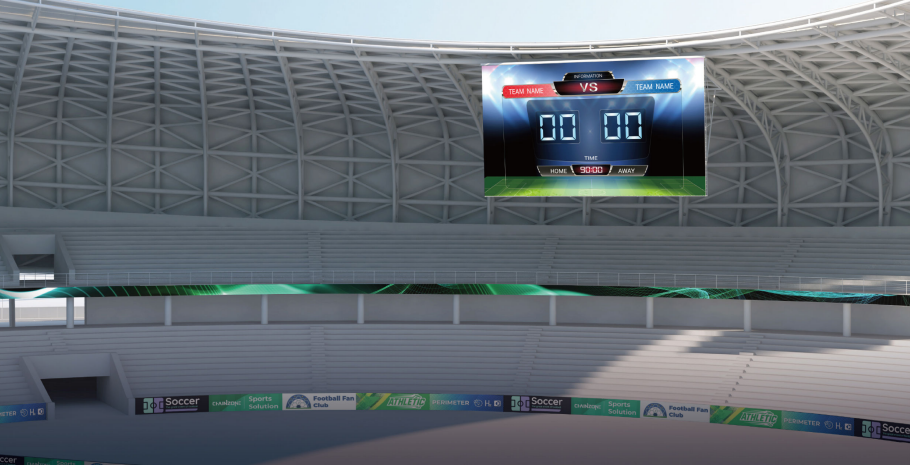
Furthermore, this type of screen (e.g., a stadium scoreboard) may require a narrow upward vertical viewing angle but a wider downward viewing angle.
How to Choose the Right Viewing Angle for Your Project
Selecting the correct display viewing angle starts with understanding the geometry of your audience.
1. The “Wide Audience” Scenario
For concerts, city center screens, outdoor festivals, and large sports stadiums, audiences are spread across a broad arc — in front of the screen, to the sides, and at varying distances. In these environments, it is critical to choose a screen with a wide or ultra-wide viewing angle, typically 140° to 160° or beyond.
2. The “Targeted” Scenario
When a screen is positioned at the end of a long, narrow corridor, directly above a specific workstation, or facing a single-lane queue, virtually all viewers approach from a near-direct front angle. In these cases, a narrower viewing angle — often around 100° or less — is actually advantageous.
3. The “Height” Factor
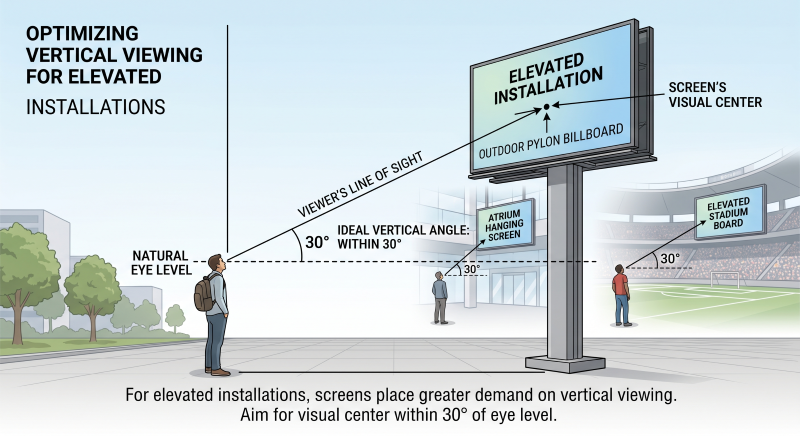
Screen installation height has a direct bearing on vertical viewing angle requirements and viewer ergonomics. For elevated installations — such as outdoor pylon billboards, atrium hanging screens, or elevated stadium boards — viewers must look upward, placing greater demand on the vertical viewing angle. Planning should aim to keep the screen’s visual center within 30° of the viewers’ natural eye level.
Where height is unavoidable and the screen is of small or medium size, physically tilting the screen downward toward the audience area helps bring the majority of viewers back within the optimal viewing cone, while simultaneously reducing glare from ambient light sources hitting the screen surface.
Chainzone Offers Professional LED Displays
Chainzone offers LED display solutions designed for different viewing angle requirements across application scenarios. For example, highway roadside billboards typically require a narrower viewing angle, as audiences approach from specific directions, while football stadium perimeter displays demand a much wider viewing angle to ensure visibility for spectators surrounding the entire field.
A key highlight of Chainzone products lies in our LOB technology, which integrates precision optical lenses directly onto the PCB. This technology helps improve brightness and contrast, reduce glare, and extend product lifespan through enhancing energy efficiency and physical protection.
For sports venues specifically, Chainzone provides a comprehensive stadium LED display solution, including perimeter displays, ribbon boards, scoreboards, and centerhung displays. These systems are designed with engineering expertise and can be managed through a unified control platform, ensuring consistent color calibration and synchronized brightness across all screens throughout the event.
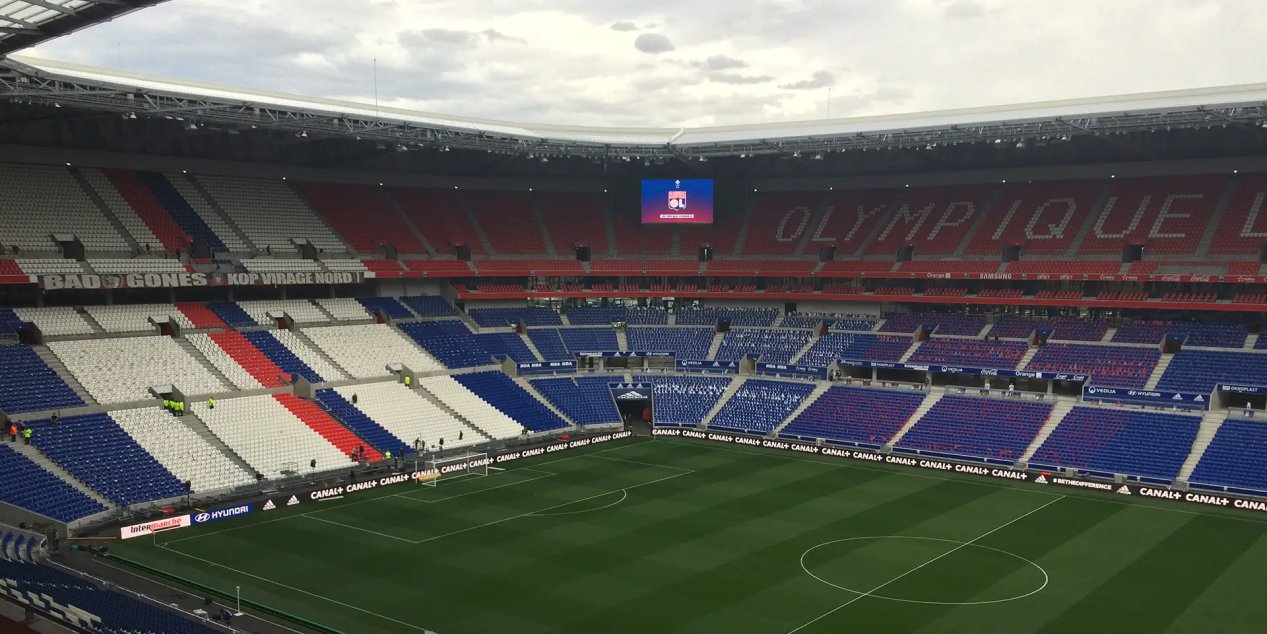
Some of our proven installations include Parc Olympique Lyonnais in France, the Korean baseball stadium, and Siu Sai Wan Sports Ground in Hong Kong, China.
Whether you need narrow-viewing-angle or wide-viewing-angle LED displays, Chainzone offers both the technical expertise and proven project experience to support your needs. Click here to learn more!


