
Escalating electricity tariffs and stringent municipal carbon caps make power efficiency the primary benchmark for outdoor digital media. Large-format digital out-of-home installations run eighteen to twenty-four hours daily across bustling metropolitan centers.
Traditional high-brightness billboards consume excessive kilowatt-hours, inflating operating budgets and accelerating thermal degradation across sensitive diode matrices.
Selecting an advanced LED display manufacturer capable of engineering low-wattage optical architectures transforms outdoor advertising from an energy liability into an eco-efficient asset. Modern energy-saving displays do not merely dim diodes; they fundamentally re-engineer light extraction, thermal dynamics, and electrical power regulation. Deploying next-generation hardware safeguards visual brilliance while slashing ongoing utility overhead.
Optical Redirection and the Physics of Direct-Beam Efficiency
Standard surface-mount diodes waste substantial electrical wattage by radiating light omnidirectionally into empty sky and upward atmosphere. Conventional billboards push excessive forward drive currents to reach readable daylight levels because unfocused beams scatter indiscriminately across unintended angles. Such brute-force illumination drives up power bills while generating severe urban light pollution.
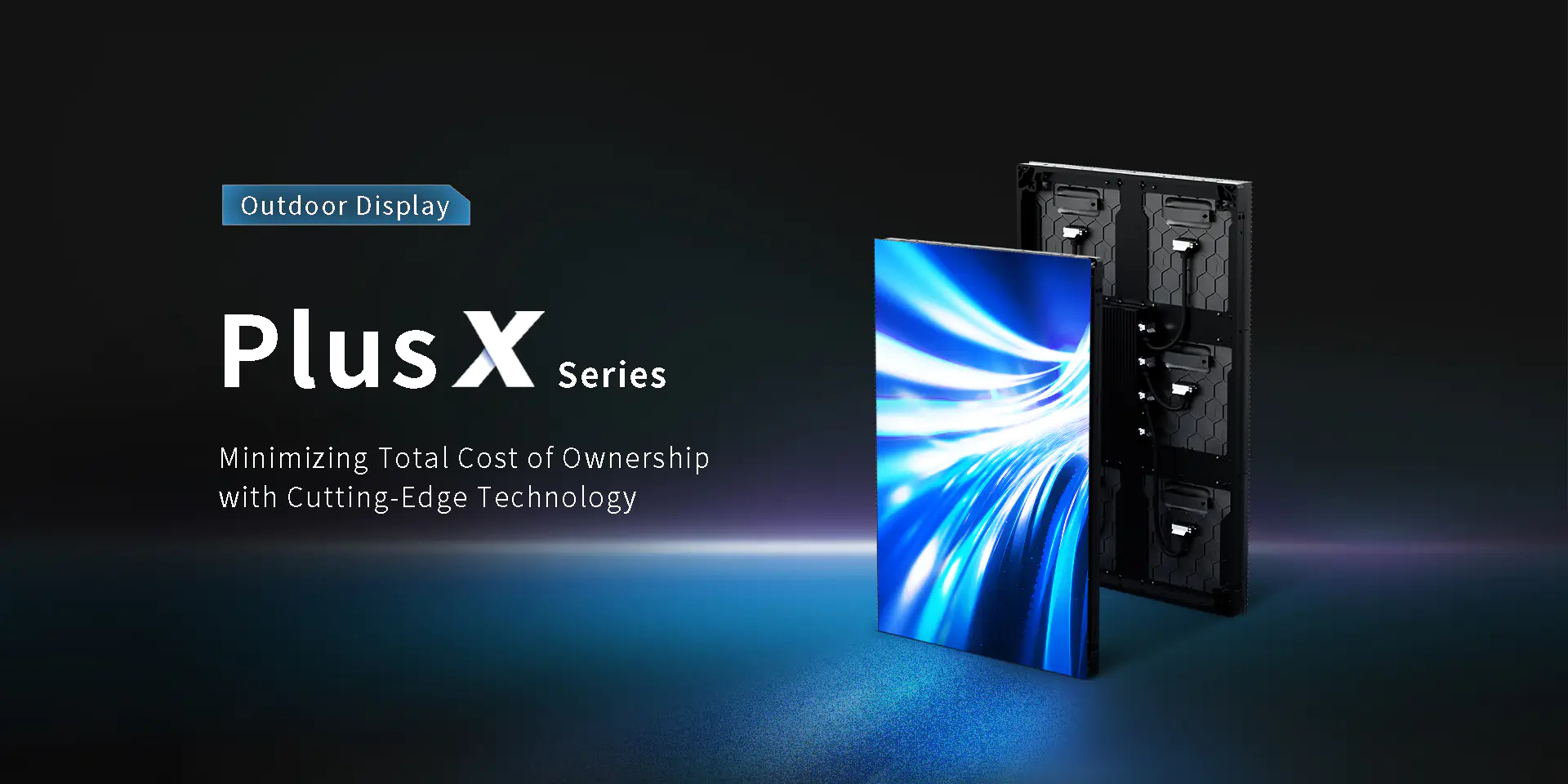
Over our twenty-five years of research at Chainzone, we developed proprietary Lens-on-Board (LOB) micro-optics to conquer this optical waste. Encapsulating each LED with a precision optical lens redirects wasted rays toward ground-level vehicular and pedestrian sightlines. Our PlusX series demonstrates that shaping light paths achieves 10,000 nits of brightness using merely 400 watts per square meter—delivering up to 50% energy savings.
Depending on its optical design, a miniLOB configuration may help improve light distribution and perceived contrast under ambient light. Its effect on reflection, black levels, and daytime contrast should be verified through product-specific optical testing. Because high contrast tricks human eyes into perceiving greater brightness, displays maintain vivid readability without burning surplus electricity.
Eliminating Active HVAC Through Thermodynamic Cabinet Engineering
Excessive heat generation remains the silent killer of outdoor LED diodes and a major contributor to auxiliary energy waste. Traditional outdoor billboards require power-hungry internal exhaust fans and dedicated air-conditioning compressors to prevent thermal throttling. Operating these electromechanical cooling systems continuously adds substantial parasitic electrical loads to monthly utility invoices.
Lowering operating current through high-efficiency optical packaging drastically curtails heat output at the semiconductor junction. Diodes running at fractional milliamps generate minimal thermal residue, allowing engineering teams to build completely sealed aluminum cabinets. Eliminating bulky heat sinks and noisy mechanical chillers removes common points of hardware failure while dropping overall power requirements.
A dedicated LED display supplier provides fully sealed IP65-rated chassis that isolate sensitive internal electronics from environmental moisture, dust, and corrosive salts. Natural passive heat dissipation through cast-aluminum frames preserves optical clarity and prevents diode color shifting. Passive cooling may reduce the number of active cooling components requiring maintenance. Operation at high ambient temperatures should be verified against the display’s rated operating range and thermal test results.
Dynamic Power Regulation and Automated Environmental Adaptation
Static power supplies operating at fixed output voltages bleed substantial energy as heat across diode drop differentials. Advanced billboard architectures utilize dynamic cathode-drive power supplies that distribute tailored voltages directly to red, green, and blue dies. Delivering lower forward voltage to red chips eliminates wasteful resistance, cutting module energy consumption immediately and lowering thermal loads.
Every qualified LED display manufacturer now integrates intelligent ambient light sensing systems that dynamically adapt screen luminance. Ambient daylight sensors can adjust display brightness based on measured light levels when supported by the control system. Dimming settings should be configured for the site’s viewing conditions and applicable regulations. Any claimed reduction in evening energy consumption should be supported by measurements against a defined baseline.
Smart load-balancing software distributes electrical currents evenly across internal power modules during high-motion video sequences. Stabilizing instantaneous power spikes protects localized power supply units from premature fatigue and electrical degradation. Smooth current delivery lowers overall utility demand charges and maintains uncompromised visual fidelity across complex commercial advertising rotations.
Global Manufacturing Standards and Accelerated Reliability Testing
Energy-efficient claims require rigorous laboratory validation before deployment across demanding roadside and urban environments. Optical distribution testing measures spatial luminous flux, beam angle uniformity, and light utilization factors across strict cross-sections. Photometric testing can help evaluate light distribution, beam characteristics, and optical utilization. Combined with electrical power measurements, these results can provide a more complete assessment of display efficiency and help identify opportunities to reduce unnecessary light output.
Rigorous verification underpins our manufacturing methodology at Chainzone, where our 1/4/4 quality control system evaluates raw components and finished modules under severe thermal stress. Our engineering laboratories perform climate chamber cycling, electromagnetic interference tests, and high-voltage resistance assessments. Having secured European EN12966 certifications, we supply world-class transportation and commercial display networks across 54 countries and regions.
Procuring screens from a certified LED display manufacturer ensures compliance with international safety and electromagnetic compatibility directives. High-efficiency switch-mode power units produce minimal electromagnetic radiation and harmonic distortion, protecting urban power grids and nearby wireless networks. Reliable certifications give municipal authorities and billboard operators total peace of mind.
Driving Sustainable DOOH Network Profitability
Transitioning to green display hardware fundamentally alters the financial calculations of digital out-of-home advertising. Reducing display power consumption can lower ongoing electricity costs and improve the operating economics of DOOH networks. The actual savings and payback period depend on the display’s power consumption, operating hours, local electricity rates, and initial equipment costs. Lower energy demand can also help media owners manage exposure to rising utility prices.
Choosing a reputable LED display supplier backed by a dedicated North American subsidiary and global engineering support protects long-term infrastructure investments. Rapid on-site technical response commitments and guaranteed spare-parts availability ensure outdoor advertising screens maintain peak uptime across decades of continuous service. Proven operational resilience protects valuable brand reputation and advertising revenue streams.
Investing in Chainzone equips network operators with proven optical systems that harmonize luminous visual power with unmatched environmental stewardship. Our landmark deployments—spanning monumental structures like The Globe at Resorts World Las Vegas to demanding subsea tunnel projects—prove that eco-friendly engineering delivers superior performance. Modern outdoor advertising achieves true sustainability when visionary optical engineering guides every pixel across the display surface.


