
Variable message signs play an important role in modern traffic management. They help road operators communicate changing information such as congestion warnings, lane closures, speed limits, weather alerts, incident notices, toll updates, and route guidance.
For global sourcing teams, however, choosing a VMS supplier is not simply a matter of comparing display size, LED color, or unit price. A variable message sign is part of a wider intelligent transportation system. Its performance depends on display visibility, structural durability, control software, communication compatibility, local standards, installation conditions, and long-term service support.
This guide explains what VMS is, what procurement teams should evaluate, and how to choose among variable message sign manufacturers for permanent, mobile, and lane-control applications.
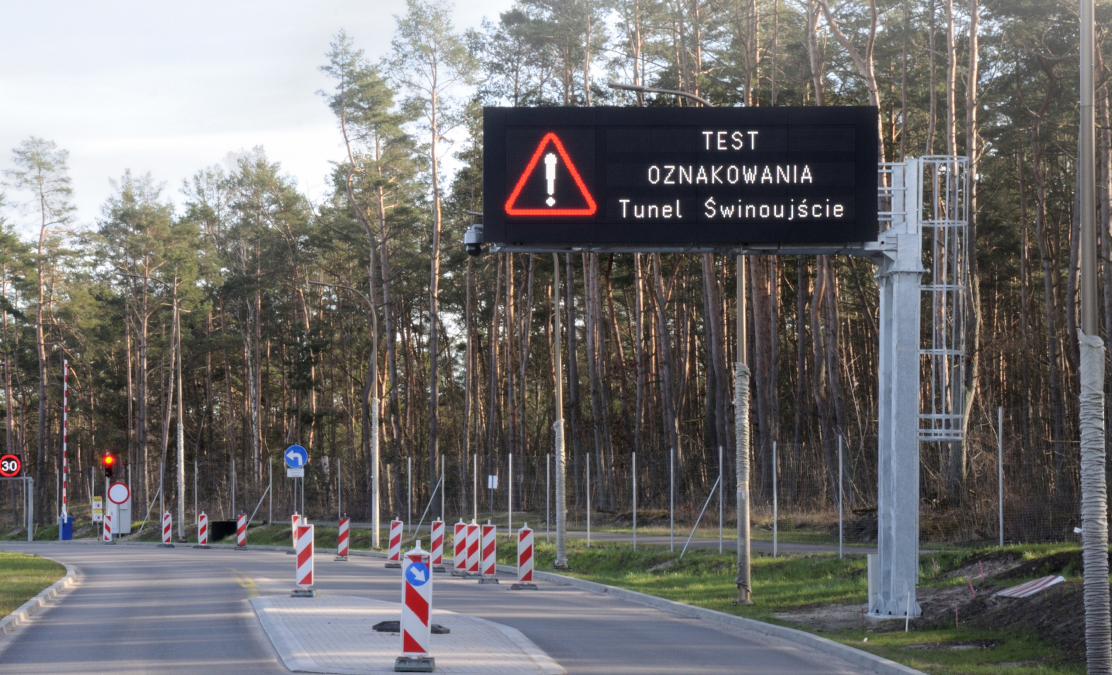
Picture shown: Chainzone EN12966 L Series VMS. Explore the complete traffic product range and project references in the Intelligent Traffic Product Brochure.
What Is VMS?
VMS stands for Variable Message Sign. It is an electronic traffic sign that can display changing text, symbols, pictograms, and other information for road users.
Unlike static road signs, a VMS can be updated remotely or locally as conditions change. For example, a road authority may use a fixed VMS to warn drivers about an accident ahead, display a diversion route, communicate travel times, or advise reduced speeds during poor weather.
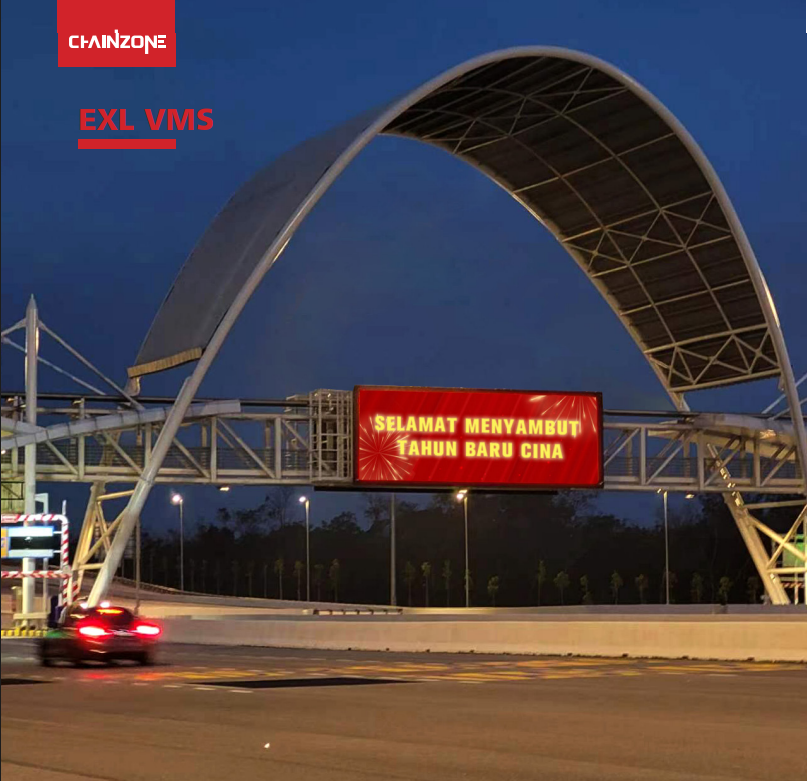
Picture shown: Chainzone EXL fixed VMS
Variable message sign traffic applications commonly include:
- Highways and motorways
- Urban roads and intersections
- Tunnels and bridges
- Toll plazas
- Work zones and construction sites
- Airports, ports, and logistics facilities
- Event traffic management
- Emergency-response routes
- Smart-city transportation networks
Depending on the project, a VMS may be installed permanently on a gantry, roadside pole, bridge structure, or tunnel entrance. It may also be mobile, trailer-mounted, or vehicle-mounted for temporary traffic control.
Because drivers often view these signs at speed and in demanding outdoor conditions, readability, accuracy, response time, and reliability are essential. A sign that is difficult to read, incompatible with the control center, or unavailable during an incident can create operational and safety challenges.
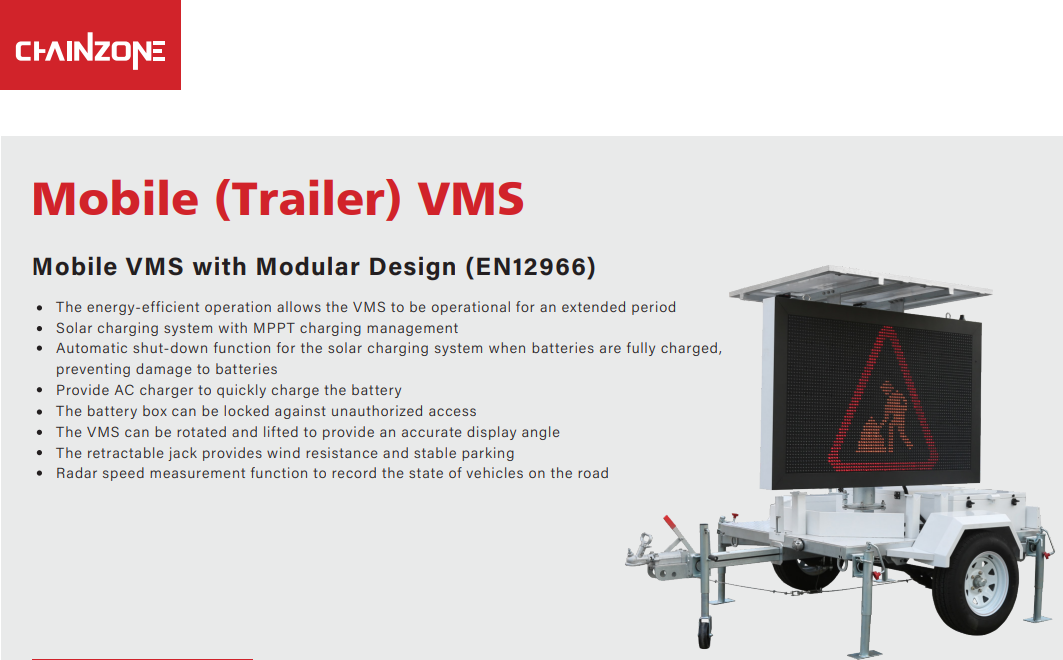
Picture shown: Chainzone trailer-mounted VMS
How to Choose a Variable Message Signs Manufacturer
As a brief summary, the VMS procurement decision should consider the following relationship:
Display quality + Control compatibility + Project engineering + Long-term support = Operational value
A low initial quotation may not represent the lowest long-term cost if the sign requires complex third-party integration, frequent maintenance, difficult spare-parts sourcing, or replacement before the expected service life.
Step 1: Define the Project Requirements First
Before approaching suppliers, create a clear technical and operational brief. This allows sourcing teams to compare proposals on a consistent basis instead of evaluating incomplete or incomparable quotations.
Key requirements to define include:
- Application type: Permanent highway VMS, urban information sign, mobile VMS, vehicle-mounted VMS, lane sign, arrow board, or tunnel traffic sign.
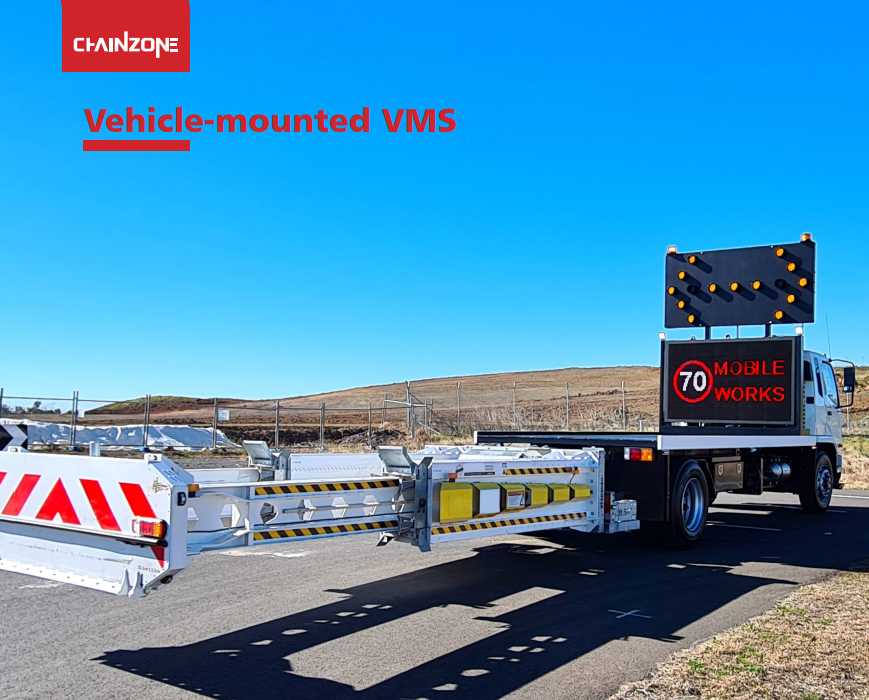
Picture shown: Chainzone vehicle-mounted VMS
- Installation location: Gantry, roadside pole, bridge, tunnel portal, work zone, temporary roadside deployment, or vehicle roof.
- Viewing conditions: Road speed, viewing distance, lane count, mounting height, ambient light, and required character height.
- Message format: Text only, text and pictograms, full-color graphics, lane-control symbols, speed information, or multilingual content.
- Power supply: Grid power, solar power, battery support, hybrid systems, or mobile generator compatibility.
- Communication method: Fiber, Ethernet, cellular network, wireless communication, local control, or connection to a central traffic-management platform.
- Environmental conditions: High heat, low temperatures, heavy rainfall, snow, strong wind, dust, humidity, coastal salt exposure, or tunnel conditions.
- Local regulations: Applicable traffic, electrical, EMC, structural, safety, and procurement specifications in the destination market.
This early step prevents a common sourcing mistake: selecting a standard product first and discovering later that it cannot meet the installation, communication, or approval requirements of the project.
Step 2: Verify Standards and Protocol Compatibility
Standards and communication protocols should be evaluated before comparing detailed product specifications. Requirements vary by country, region, road authority, and project type.
For example, European public-road projects may require VMS products that meet relevant EN 12966 requirements. North American projects may require compatibility with NTCIP-based traffic-management environments. Other markets may use regional protocols or traffic-control architectures, including RSMP, NMCS2, or TLS-based requirements.
It is important to distinguish between these categories:
| Evaluation Area | What It Covers | Questions for Suppliers |
| Product compliance | Product performance, safety, electrical, optical, and environmental requirements | Which test reports and certificates apply to this exact product configuration? |
| Communication protocol | Data exchange between the sign, controller, and traffic-management system | Which protocols can the system support, and what integration documentation is available? |
| Project specification | Requirements set by a road authority, consultant, or contractor | Can the proposed configuration meet the tender’s stated technical requirements? |
| System integration | Connection with existing software, devices, or control centers | Has the supplier integrated with similar central systems before? |
Do not assume that a supplier’s general certificate or protocol statement automatically applies to every product model or country. Ask for documentation that matches the proposed sign, controller, communication method, and destination market.
A capable manufacturer should be able to explain the scope of its compliance documents, identify any project-specific integration work, and clarify what is included in the supply package.
Step 3: Assess Display Performance and Engineering Quality
A VMS must remain readable in changing daylight, weather, and traffic conditions. Procurement teams should review practical performance rather than relying only on broad claims such as “high brightness” or “excellent visibility.”
Important technical areas include:
LED Visibility and Automatic Brightness Control
The sign should provide clear visibility in direct sunlight while avoiding excessive glare at night. Automatic brightness adjustment helps the display respond to ambient light conditions and can support more consistent driver readability.
Ask how the brightness-control system operates, whether light sensors are included, and how brightness settings can be configured or monitored.
Pixel Pitch, Character Height, and Viewing Distance
Pixel pitch should be considered together with sign size, message format, road speed, and required viewing distance. A smaller pixel pitch is not automatically the right choice for every traffic application.
For long-distance highway viewing, sufficient character height and well-designed message layouts are often more important than using the smallest available pixel pitch. Suppliers should help specify a configuration based on the actual road environment.
Cabinet Design and Maintainability
The cabinet should protect internal components while allowing service personnel to access modules, power supplies, controllers, and wiring safely.
Evaluate:
- Cabinet material and corrosion resistance
- Door design, locks, seals, and internal access
- Drainage and ventilation design
- Maintenance access from the front or rear
- Modular replacement procedures
- Wiring organization and labeling
- Lightning protection and grounding provisions
For permanent roadside infrastructure, maintainability can strongly affect lifecycle cost and traffic-disruption risk during repairs.
Step 4: Evaluate Environmental Adaptability
Fixed VMS, mobile VMS, and lane signs may operate in very different climates. A sign designed for a mild urban setting may need additional engineering for desert heat, snow, coastal corrosion, heavy rainfall, or tunnel environments.
Sourcing teams should share local environmental data early and ask manufacturers how the product will be configured accordingly.
Relevant questions include:
- What operating-temperature range is specified for the proposed configuration?
- How does the cabinet manage heat dissipation in high-temperature locations?
- What protection measures are available for humid or salt-laden coastal environments?
- How are sealing, drainage, and moisture control managed?
- Is the structure designed for local wind-load requirements?
- What testing or quality records can support these claims?
Chainzone provides project-based traffic display configurations for fixed VMS, mobile VMS, and lane-sign applications. This approach allows product design to account for the installation environment, local operating conditions, power availability, communication requirements, and project specifications rather than treating every deployment as identical.
Step 5: Review Control Systems and ITS Integration
The control system is one of the most important areas in VMS sourcing. A display may have strong LED performance, but its operational value is limited if it cannot communicate reliably with the traffic-management system.
Some LED suppliers provide only the physical display, requiring customers to purchase or integrate a separate control platform. This can create additional coordination work among the display manufacturer, software provider, system integrator, and road authority.
A stronger option is a manufacturer with integrated display and control-system capabilities.
Chainzone has developed and continuously improved more than ten mainstream traffic control systems. Our traffic display solutions can support regional protocol requirements, including NTCIP in the United States, RSMP in parts of Europe, NMCS2 in the United Kingdom, and TLS in Germany, depending on project requirements.
For sourcing teams, this capability can support a more coordinated procurement process by aligning the VMS hardware, controller, communication interface, and central-system integration strategy.
When evaluating a supplier, ask for:
- Supported communication protocols and interface specifications
- Remote-control and status-monitoring functions
- Alarm and fault-reporting capabilities
- Message scheduling and priority-management options
- User-permission and access-control features
- Cybersecurity responsibilities and network requirements
- Integration examples for comparable projects
- Training, manuals, and technical support for operators
Step 6: Check Manufacturing, Testing, and Supply Reliability
A supplier’s brochure may show attractive products, but sourcing teams should also assess how those products are made, tested, packed, delivered, and supported.
Useful due-diligence questions include:
- Does the manufacturer have dedicated traffic-product engineering and production capabilities?
- How are LEDs, power supplies, controllers, cabinets, and communication components inspected?
- What factory testing is performed before shipment?
- Can the supplier support factory acceptance testing when required?
- How are serial numbers, configurations, and quality records tracked?
- What is the expected production lead time for the required quantity?
- How does the supplier manage critical component availability?
- Can the supplier provide installation guidance and site-acceptance support?
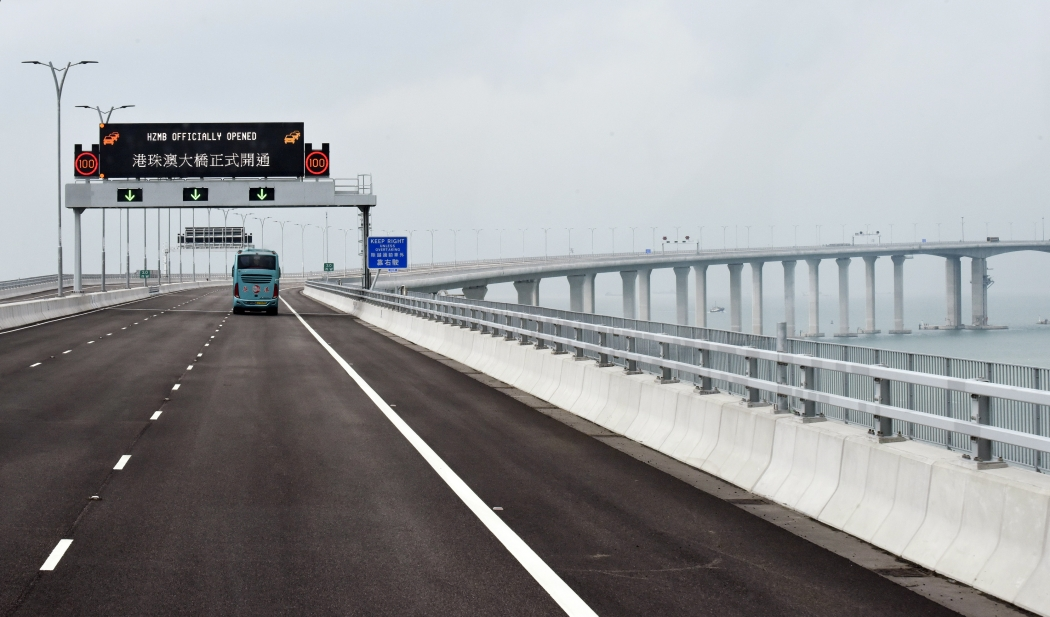
Chainzone’s traffic portfolio includes fixed VMS, mobile VMS, vehicle-mounted VMS, lane-control-related displays, arrow boards, and other intelligent traffic display solutions. Our traffic display projects include traffic guidance applications associated with major infrastructure environments, including the Hong Kong-Zhuhai-Macao Bridge project.
Step 7: Compare Total Cost of Ownership
Initial purchase price matters, but it should not be the only financial criterion. A better evaluation considers the total cost of ownership throughout the sign’s operating life.
Compare:
- Equipment purchase price
- Shipping and packaging requirements
- Structural and installation costs
- Power consumption
- Communication and software-integration costs
- Commissioning and training requirements
- Warranty duration and coverage
- Spare-parts pricing and availability
- Routine maintenance needs
- Expected repair-response process
- Potential costs of sign downtime
A sourcing team can make comparisons clearer by asking each supplier to complete the same technical and commercial response template. This makes it easier to identify differences hidden behind a lower unit price, such as excluded control software, limited warranty terms, unavailable local support, or incomplete installation accessories.
Use a Final VMS Supplier Checklist
Before selecting a VMS manufacturer, confirm that the supplier can provide satisfactory answers in these areas:
- The product fits the intended traffic application.
- The proposal addresses local standards and tender requirements.
- The sign supports the necessary protocol and central-system integration.
- Display readability is appropriate for the viewing environment.
- Cabinet, structure, and components are configured for local weather conditions.
- Testing, inspection, and acceptance procedures are documented.
- The manufacturer can provide realistic production and delivery commitments.
- Warranty, spare parts, training, and technical support are clearly defined.
- The total cost of ownership has been compared, not only the unit price.
- Comparable project experience supports the supplier’s capability.
Partner with Chainzone for Project-Ready VMS Solutions
Chainzone is your reliable partner who provides project-based VMS solutions for road authorities, traffic engineering contractors, system integrators, and global procurement teams.
Why Consider Chainzone?
- Integrated traffic display and control capability: Chainzone develops both traffic display equipment and control systems, helping customers avoid unnecessary coordination between separate display, controller, and software suppliers.
- Regional protocol compatibility: Chainzone VMS solutions can be configured to support regional traffic communication protocols, including NTCIP for the United States, RSMP in parts of Europe, NMCS2 in the United Kingdom, and TLS in Germany, according to project requirements.
- EN 12966 VMS solutions: Chainzone provides EN 12966-compliant VMS for European public-road projects. The relevant performance aspectsinclude optical performance, environmental and structural adaptability, electrical safety, and electromagnetic compatibility.
- Optical lens design: Chainzone uses optical lens technology(LOB technology) designed to support brightness, contrast, legibility, and controlled light distribution in varying outdoor lighting conditions. The UV-resistant, self-cleaning lens surface is intended to support display clarity and weather resistance during long-term outdoor operation.
- Project-specific configuration: Fixed VMS, mobile VMS, and lane-related traffic displays can be configured according to viewing distance, installation location, message format, local climate, power supply, communication method, and maintenance requirements.
Chainzone VMS Product Range
| Product Type | Typical Applications | Sourcing Value |
| EN 12966 Fixed/Overhead VMS | Highways, arterial roads, bridges, toll plazas, and permanent road infrastructure | Supports European public-road projects requiring EN 12966-compliant solutions. |
| Trailer-Mounted VMS | Construction work zones, roadworks, events, and temporary detours | Enables flexible short-term deployment for temporary traffic management. |
| Vehicle-Mounted VMS | Maintenance vehicles, construction fleets, emergency-response vehicles, and patrol operations | Delivers dynamic warnings and guidance at the point of traffic disruption. |
| EXL VMS (Fixed VMS) | Urban roads and installations with space or energy-use constraints | Provides a lightweight, energy-efficient option for urban traffic communication. |
| Walk-In VMS | Busy roads, constrained installation sites, and projects with frequent maintenance needs | Allows internal maintenance access and supports more convenient servicing. |
| Arrow Boards | Lane closures, merging traffic, detours, and construction zones | Provides clear directional guidance for temporary road-control applications. |
Experience Across Traffic Environments
Chainzone has supported VMS and traffic-display deployments across a range of international transportation environments, including highways, expressways, tunnels, and major cross-border infrastructure projects.
- Poland’s National Highways: Chainzone supplied more than 152sets of VMS and traffic-display products for national highway upgrades, supporting speed-limit communication, road-condition updates, and real-time traffic guidance.
- Malaysia’s North–South Expressway: Chainzone delivered more than 70sets of intelligent traffic-display products for this major expressway network, supporting dynamic traffic information and safer road operations.
- Qatar Intelligent Traffic Guidance System: Chainzone supplied more than 150sets of traffic-display products for the project, supporting real-time traffic guidance and intelligent transportation management in a high-demand road environment.
- Norway’s Ryfast Undersea Tunnel: Chainzone supplied more than 2,000sets of high-visibility traffic-display products for this complex tunnel project, supporting traffic-information communication and road safety management in an enclosed infrastructure environment.
- Hong Kong-Zhuhai-Macao Bridge: Chainzone supplied more than 600 sets of self-developed traffic-display products for the Hong Kong section, supporting its intelligent traffic-guidance system.
Discuss Your VMS Project With Chainzone
Whether the requirement involves a fixed motorway VMS, a trailer-mounted sign for work-zone management, a vehicle-mounted VMS for incident response, or an integrated traffic-control project, Chainzone can support product selection and project discussion.
Contact Chainzone to discuss VMS specifications, EN 12966 requirements, protocol compatibility, environmental conditions, and traffic-system integration needs!


