
Deploying dynamic visual communication across modern screens requires balancing creative artistry with rigorous technical execution. Content crafted on desktop monitors often fails outdoors where ambient daylight, wide viewing angles, and long distances dictate how audiences perceive digital media. Without engineering-minded preparation, vibrant graphics quickly degrade into illegible glare.
Operating an impactful digital signage network demands a continuous operational workflow that bridges graphic production, dynamic playlist automation, and remote hardware supervision. Delivering clear, contextually relevant messaging while protecting commercial capital requires operators to align software management directly with physical display capabilities.
Aligning Creative Specifications with Screen Hardware and Environmental Contrast
Creative production must begin with an exacting audit of physical display geometry, native resolution, and pixel pitch. Unlike consumer monitors with standardized aspect ratios, commercial modular video walls feature custom canvas dimensions where scaling non-native assets introduces blur, distortion, and awkward letterboxing that immediately compromise brand presentation.
Visual hierarchy dictates that typography and branding remain bold, uncluttered, and readable from maximum distances. Selecting high-contrast palettes—pairing stark light elements against deep, saturated backgrounds—ensures critical text cuts through ambient reflections, whereas delicate serif fonts and subtle pastel gradients wash out completely under bright sunlight.
Outdoor installations, especially monumental LED billboards, demand robust luminance capabilities reaching up to 10,000 nits to cut through direct midday sunlight. Motion assets and video sequences also require ultra-high refresh rates of up to 7680Hz, which prevents scan lines and visual stutter when captured by mobile cameras or viewed from passing transit.
At Chainzone, we engineer optical display systems utilizing proprietary Lens-on-Board (LOB) technology, integrating precision optical lenses directly across diode surfaces. Such specialized packaging enhances optical efficiency, suppresses glare, and sharpens contrast, ensuring advertising graphics retain striking depth without overdriving electrical consumption.
Organizing Display Schedules Around Viewer Dwell Time and Dayparting
Effective content programming aligns message duration directly with audience dwell times across specific deployment zones. Content duration should reflect the audience’s likely viewing opportunity: transit-platform displays can support longer informational messages, while roadside billboards should prioritize brief headlines and simple messages that drivers can recognize at a glance.
Modern digital signage management platforms resolve this pacing challenge through automated dayparting, rotating creative assets to match shifting demographic habits across morning, midday, and evening cycles. Quick-service menus transition seamlessly from breakfast combos to dinner promotions, while roadside communications shift toward high-contrast nighttime palettes that reduce driver eye strain.
Conditional scheduling algorithms elevate network utility by triggering hyper-relevant messaging in response to dynamic environmental inputs. Connecting media players to live data feeds enables playlists to automatically display umbrella promotions during sudden rainfall, broadcast emergency traffic advisories during highway slowdowns, or update stock inventory levels without manual scheduling intervention.
Balancing commercial advertising with useful community updates maintains high viewer engagement across repeated exposures. Dividing screen layouts into dedicated visual zones—pairing primary brand video with localized weather updates and live news tickers—encourages passersby to look at displays repeatedly throughout their daily commute.
Centralizing Playback Control and Real-Time Diagnostic Monitoring
Network administrators managing multi-site LED billboards depend on centralized cloud management platforms to orchestrate asset distribution across geographically scattered endpoints. Centralized digital signage management platforms can support batch asset uploads, playback schedule management, and proof-of-play reporting when these functions are available. Such reports can help DOOH media buyers and brand stakeholders review recorded playback activity.
Secure content distribution requires robust edge-device management, utilizing encrypted data tunnels and local storage caching to protect against network interruptions. Local media players should store scheduled assets in onboard memory so that cached content can continue playing during temporary network outages, provided the playback system and display remain operational.
Routine operational oversight must extend beyond media playlists into active hardware telemetry. Integrated environmental sensors track internal cabinet temperatures, incoming electrical currents, and humidity levels, providing maintenance teams with early warning indicators long before hardware components experience heat stress or intermittent signal dropouts.
Chainzone‘s display solutions can be configured with monitoring and redundancy features where supported by the selected model. Maintenance procedures and service continuity depend on the hardware architecture, monitoring capabilities, and applicable maintenance requirements.
Tailoring Content Deployments Across High-Traffic Venues
Distinct architectural settings demand dedicated content formatting strategies tailored to physical viewer positioning and environmental conditions. Media assets crafted for pedestrian shopping plazas require completely different scaling, motion pacing, and textual density than graphics engineered for sports stadiums, public transit hubs, or roadside display corridors.
Retail centers and entertainment districts thrive on high-density digital signage that immerses shoppers in branded visual storytelling and interactive wayfinding. Content creators operating in these indoor environments should utilize fine-pitch displays, rich color gamuts, and subtle motion transitions to guide foot traffic, announce limited-time promotions, and elevate overall store ambiance.
Highway corridors and prominent urban landmarks rely on monumental LED billboards engineered for extreme environmental resilience. Operating within rugged IP65 or IP67 weatherproof enclosures, roadside screens require content optimized with community-friendly directional optical angles, high-contrast typography, and strict luminance regulation that avoids light pollution in adjacent residential zones.
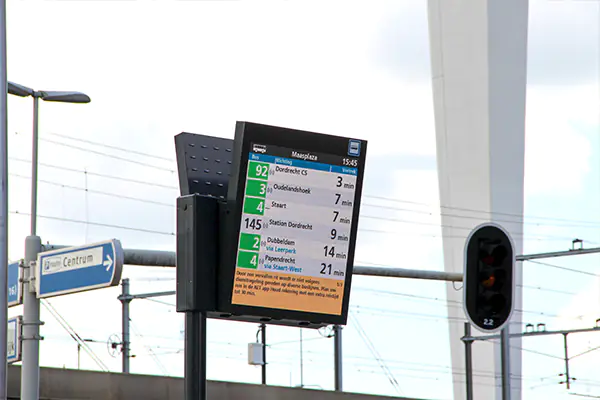
Transportation terminals and international airports unite high-impact advertising with mission-critical passenger wayfinding and departure schedules. Synchronizing commercial sponsorships with real-time transit announcements across concourses and boarding gates creates a cohesive visual ecosystem that informs travelers while unlocking lucrative recurring revenue streams for facility operators.
Sustaining Operational Longevity and Visual Performance
Safeguarding return on investment over years of continuous operation requires matching compelling content with durable hardware engineering. We develop energy-efficient display architectures with advanced thermal management and protective optical packaging, designed to help manage thermal stress, mitigate the risk of diode discoloration, and support lower total cost of ownership over the product lifecycle.


