
Evaluating an LED display investment means looking beyond the price tag. The gap between a $15,000 screen and a $60,000 one rarely comes down to quality alone — it reflects pixel pitch, technology, installation complexity, and how the screen will perform over five or more years. This guide breaks down what LED displays actually cost, how to calculate ROI, and how to identify the best value versus a low number that only looks good until the project goes live.
Overview: LED Display Costs, ROI, and Best Value
- Hardware typically accounts for only 40–70% of a project’s total budget
- ROI depends on revenue sources, CPM efficiency, and long-term operating costs
- Total cost of ownership (TCO) over 5 years matters more than purchase price
- Pixel pitch selection and energy technology are the two biggest levers for maximizing value
What Does an LED Display Actually Cost?
The short answer: hardware cost ranges from roughly $8,000 for a small outdoor unit to over $300,000 for a large-format billboard. But hardware is only part of the picture.
1. Hardware Is Only 40–70% of the Total Budget
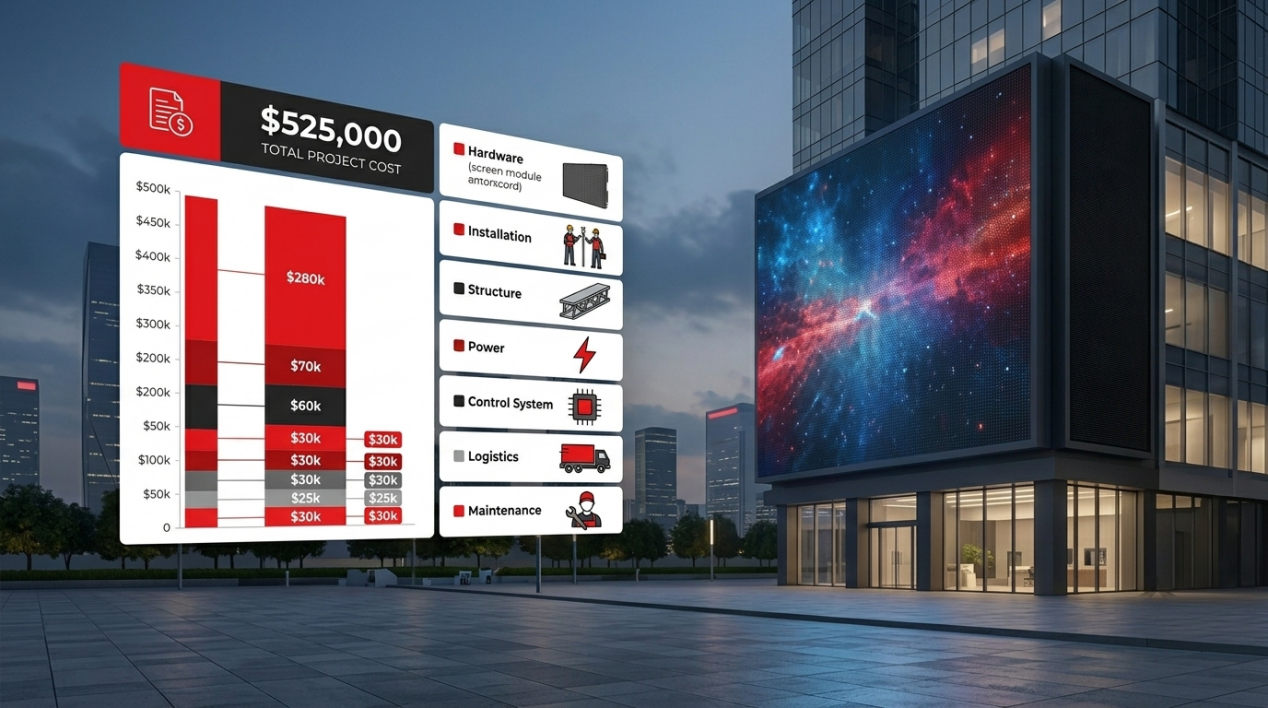
Most buyers focus on the screen price and underestimate everything around it. In a typical project, the display module accounts for roughly 40–70% of total spend. The rest covers structural support, power infrastructure, control hardware, and content management software (CMS). The following figures are indicative industry estimates and vary by project.
| Budget Item | Typical Share | Key notes |
| LED display hardware | 40–70% | Includes LED modules, cabinets, and power supplies. For tight budgets, this may reach up to 70% |
| Steel structure & foundations | 10–20% | Varies by site; concrete wall mounts are ~10–15%, while complex facades or monopoles can reach 20% |
| Electrical infrastructure | 3–10% | Includes dedicated power distribution boxes, circuit wiring, and capacity upgrades |
| Control system & cabling | 5–10% | Includes sending/receiving cards, video processors, and data/power cables |
| CMS software & setup | 1–8% | Ongoing or one-time fees for cloud-based Content Management Systems |
| Logistics, permits, labor | 5–15% | Includes ocean/air freight (3–8%), import duties (2–7%), and local zoning/building permits (2k-15k+) |
Understanding this structure upfront prevents budget shortfalls mid-project. For a detailed breakdown by screen size and configuration, see How Much Does an Outdoor LED Billboard Cost?
2. What Drives the Hardware Price Up or Down?
- Pixel pitch is the dominant cost driver. Pixel pitch (P, measured in mm) is the distance between the centers of two adjacent pixels. A P4 display packs four times the pixel density of a P8, and manufacturing cost rises sharply as pitch decreases. For viewing distances of 10 meters or more, a P10 delivers adequate image quality; specifying P4 at that range adds significant cost with no perceptible benefit.
- Packaging technology affects both price and long-term performance. Standard SMD (Surface Mount Device) is the most affordable entry point. LOB (Lens on Board) technology integrates a precision optical lens onto each LED, concentrating light output for higher brightness at the same power draw — relevant to operating costs over time.
- Indoor vs. outdoor rating creates a consistent cost premium. Outdoor screens must deliver 5,000–10,000+ nits and carry at least an IP65 ingress protection rating. These requirements typically price outdoor screens 30–50% higher than a comparable indoor unit.
What Hidden Costs Do Most Buyers Underestimate?
Most cost surprises in LED projects come from areas that don’t appear on the hardware quote.
1. Installation and Structural Infrastructure
For fixed outdoor displays, structural work — steel frames, concrete foundations, and civil work — typically adds 10–20% to total project cost. Complex installations (curved surfaces, rooftop mounts, high-wind sites) push this to 20–40% of hardware value. Crane rental, licensed electrical work, and local permits are consistently underbudgeted.
2. Long-Term Operating Costs: Electricity and Maintenance
Electricity is the highest ongoing cost for any LED display, and the most frequently underestimated at the procurement stage. High-efficiency LOB-technology screens can reduce power consumption by up to 80% versus standard SMD at equivalent brightness. Chainzone’s Plus X series utilizes the miniLOB technique to achieve 10,000 nits at 400W—approximately 50% less energy than typical outdoor displays with comparable brightness. For a technical comparison of display energy use, see What Is the Most Energy-Efficient Digital Display?
Routine maintenance — annual cleaning, calibration, and module replacement — typically costs 2–5% of hardware value per year. Budget 5–10% spare modules from the same production batch to ensure color consistency in future replacements.
How Do You Calculate LED Display ROI?
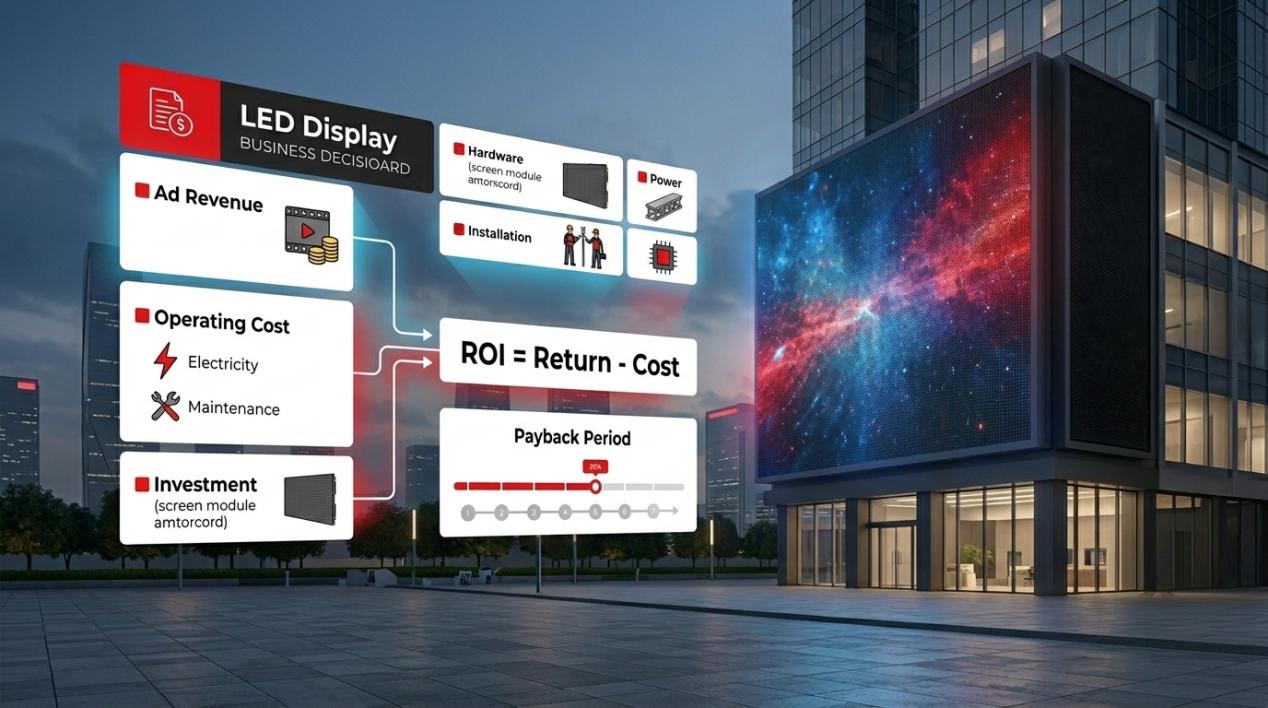
For well-located outdoor advertising screens operating at reasonable utilization rates, payback periods typically range from 2 to 5 years, varying by site traffic, advertising occupancy, and local market rates.
Where Does the Return Actually Come From?
- Direct advertising revenue is the primary income source for DOOH (Digital Out-of-Home) operators. Unlike static billboards locked to a single advertiser, a digital screen can rotate multiple campaigns per hour. The DOOH market is tracking consistent momentum: U.S. out-of-home advertising revenue reached a record $9.46 billion in 2025, with DOOH accounting for 36.3% of that total and growing 10.5% year-over-year — its 19th consecutive quarter of growth ( OAAA, 2025 Full-Year OOH Revenue Report, March 2026). Globally, the DOOH advertising market was valued at $20.17 billion in 2025 and is projected to reach $56.1 billion by 2034, growing at a 12.09% CAGR ( Fortune Business Insights, Digital Out-of-Home Advertising Market Report, 2025).
- CPM efficiency makes LED displays competitive against traditional media. LED displays in high-traffic outdoor locations deliver CPMs typically ranging from $2 to $8 for traditional OOH formats — and $2 to $15 for programmatic DOOH — compared to $45–$196 for print formats such as newspapers and magazines. This efficiency gap supports stronger advertiser demand and higher occupancy rates for display operators.
- Sales lift adds a return channel that doesn’t require direct ad revenue. Dynamic digital signage drives measurable uplifts in foot traffic and on-site spending in retail and venue environments.
Want to know how Chainzone’s display solutions support revenue-generating DOOH deployments?, Click here to see DOOH Advertising Solutions.
Cheap vs. Quality LED Displays: What’s the Real 5-Year Cost Difference?
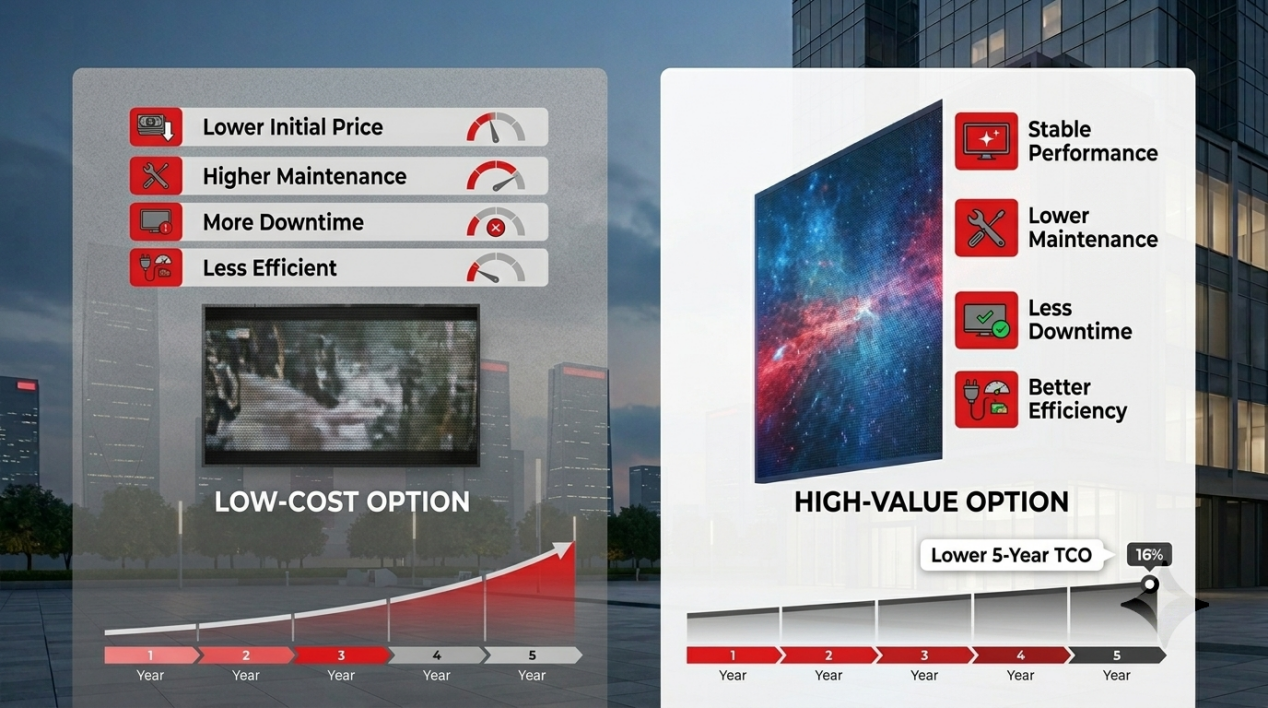
A screen priced 30% below the market average is not automatically a better deal. TCO over five years often reverses the apparent saving.
1. Why a Lower Purchase Price Can Cost More Over Time
Low-cost displays cut corners in three predictable areas: LED chip grade, drive IC quality, and encapsulation protection. Each has documented downstream consequences:
- Brightness degradation: Lower-grade chips operating in high-temperature outdoor environments at sustained high brightness can exhibit brightness loss of 20–30% within 12–24 months of continuous operation — compared to 3–5 years before any visible degradation on quality units.
- Color uniformity failure: Noticeable color shift typically appears within 12–18 months on budget screens, compared to 3–5+ years on quality units.
- Higher maintenance frequency: Cheap screens typically require calibration every 4–6 months; quality displays run on 12-month cycles.
The net result: a screen purchased at 30% below market can generate 5-year ownership costs 200% higher than a quality alternative, once electricity, calibration, module replacement, and downtime are included.
2. What Separates a Reliable Display from a Budget One?
The key quality indicators to check before purchasing:
- LED chip brand and wire type: Gold-wire bonding offers significantly better oxidation resistance than copper-wire alternatives, particularly in outdoor or high-humidity environments. Specify bonding material in the quote for any outdoor installation.
- Drive IC specification: High-refresh-rate ICs (3,840 Hz and above) reduce flicker and support broadcast-quality image capture — relevant for sports venues and any application where content is filmed.
- Encapsulation method: LOB technology physically protects each LED with a precision lens, reducing UV exposure, moisture ingress, and impact damage. Learn more about Chainzone’s LOB technology
- Power supply architecture: Redundant power backup circuits prevent single-point failures — a real revenue risk for 24/7 advertising displays.
How Do You Choose the Best-Value LED Display for Your Project?
Best value is the specification that delivers required visual performance at the lowest total cost over the operating life — not the lowest line item on the quote.
1. Match Pixel Pitch to Viewing Distance — Don’t Over-Spec
The practical rule: pixel pitch (mm) ≈ minimum viewing distance (m). A P10 is appropriate for 10-meter viewing; specifying P4 at that distance adds cost with no visible improvement.
| Application | Min. Viewing Distance | Recommended Pitch | Outdoor Brightness Req. |
| Highway / rooftop billboard | 20–100 m | P8–P16 | 6,000–10,000 nits |
| Roadside retail / transit hub | 5–20 m | P4–P8 | 5,000–8,000 nits |
| Stadium scoreboard / perimeter | 10–40 m | P6–P10 | 5,000–8,000 nits |
| Corporate lobby / reception (indoor) | 3–8 m | P2.5–P4 | 800–1,500 nits |
| Control room / broadcast studio (indoor) | 1–3 m | P1.2–P2 | 600–1,000 nits |
Over-specifying resolution is one of the most consistent sources of unnecessary spend in LED projects. Chainzone’s guide to choosing the right pixel pitch covers this calculation across common deployment types.

2. Factor Energy Efficiency into the TCO Equation
Energy cost becomes the largest single line item over a quality display’s operational lifespan — typically 6–10 years for well-maintained outdoor screens — for high-brightness units running extended daily hours. Displays with advanced energy technology achieve the same brightness at substantially lower draw. The V-Plus series reaches 10,000 nits with a 7,680 Hz refresh rate through LOB optical architecture and centralized power management.
When comparing supplier quotes, ask for average power consumption at 25% brightness rather than peak power — this is the figure that reflects real operational draw and determines your electricity bill.
Key Takeaways
- Total project cost = hardware + installation + infrastructure + software + spare parts. Hardware is 40–70% of the whole.
- ROI comes from advertising revenue, CPM efficiency, and sales lift— calculate expected payback period before locking in specifications.
- A 5-year TCO analysis often reverses the apparent advantage of the cheapest quote.
- Match pixel pitch to viewing distance. Over-specifying resolution is a predictable budget leak with no operational upside.
- Energy technology affects profitability over time. For high-utilization outdoor screens, the difference between standard SMD and LOB-equipped displays in electricity cost compounds significantly at scale.
Chainzone’s engineering team works with DOOH operators, system integrators, property developers, and venue operators across 120+ countries. Contact Chainzone to discuss your project requirements and get a configuration recommendation based on your site, viewing distance, and operational goals.


