
At its core, an LED billboard is a large-scale, self-illuminating outdoor digital screen that uses thousands of light-emitting diodes to broadcast vibrant visual media. Unlike conventional billboards that rely on printed paper illuminated by external floodlights, an electronic display generates direct illumination, turning roadside advertising into an active, programmable broadcast medium.
Modern LED Billboards replace printed vinyl with dynamic matrices of light-emitting diodes capable of presenting animated graphics, full-motion video, and automated data feeds. Media operators manage content remotely through networked software, transforming static roadside displays into agile communication assets that adapt to ambient conditions, scheduled time slots, and immediate messaging demands.
Architectural Anatomy and Digital Operation
Many large-format LED billboards are assembled from modular display cabinets, allowing screen dimensions and configurations to be adapted to project requirements. Microscopic semiconductors grouped into red, green, and blue clusters form individual pixels across each display module. Modulating electrical currents sent to these diodes blends primary wavelengths, generating millions of vivid colors with pinpoint optical clarity across wide viewing angles.
Behind the display modules, control and power components work together to process incoming content signals and drive the LED pixels. Internal controllers process input signals and deliver pixel data at refresh rates determined by the display specifications. Some Chainzone outdoor displays support refresh rates of up to 7,680 Hz, which can help reduce visible flicker and camera scan-line artifacts.
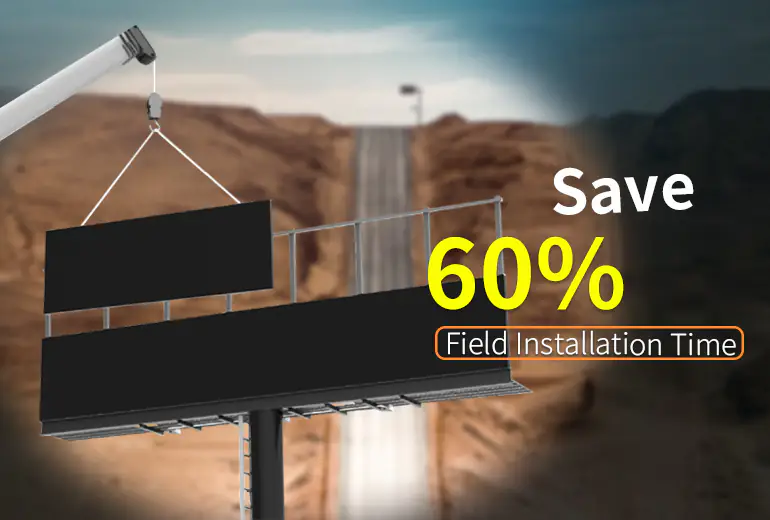
Modular cabinet architecture allows operators to scale screen dimensions from compact roadside totems to massive highway installations spanning hundreds of square meters. Modular cabinet designs can simplify installation and maintenance, while selected Chainzone outdoor display products support front and rear access to make servicing more convenient.
Chainzone’s proprietary LOB (Lens On Board) technology places optical lenses over LED chips, helping protect them from environmental exposure while improving light utilization and display contrast Such engineering safeguards image integrity against off-axis distortion, ensuring that contemporary LED Billboards retain sharp contrast even under direct midday sun.
Optical Performance and Core Operating Advantages
Direct sunlight presents the primary obstacle for any roadside visual medium. High-brightness outdoor LED billboards are designed to remain visible in daylight. For example, Chainzone’s V-Plus series offers brightness of up to 10,000 nits for demanding outdoor advertising environments. This optical power defeats ambient glare, guaranteeing crisp visual punch where static printed banners or conventional monitors appear completely washed out.
Operational flexibility fundamentally distinguishes electronic screens from legacy out-of-home advertising. Replacing static creative assets no longer requires manual poster paste-ups, crane access, or hazardous physical labor. Advertising operators can remotely update and manage display content through cloud-managed platforms, turning individual roadside displays into coordinated, revenue-generating digital signage networks.
Weatherproofing ensures dependable operation through torrential rain, high humidity, blowing dust, and seasonal temperature swings. Enclosures engineered to IP65 or IP67 standards isolate sensitive drive circuits inside sealed compartments. Silicone gaskets, treated coatings, and drainage channels prevent moisture ingress and corrosive particulate buildup over decades of continuous exposure.
Engineering breakthroughs developed at Chainzone address power consumption by pairing specialized driver chips with energy-efficient optical design. Innovative power architectures lower internal operating temperatures and cut electricity consumption by up to 80 percent. Lower power draw significantly shrinks utility expenses, delivering an exceptionally low total cost of ownership for commercial operators.
Strategic Deployment Environments and Real-World Use Cases
At Chainzone, we deploy outdoor screens across diverse urban environments where visual impact directly drives commercial engagement. High-density commercial districts rely on giant exterior screens to command foot traffic, transforming everyday building facades into dynamic landmarks that capture consumer attention and elevate surrounding property values.
Highway arterial corridors present another vital deployment category, demanding broad viewing distances and rapid legibility for motorists traveling at high speeds. Robust structural pylons support wide-format configurations where LED Billboards deliver clear, instantaneous brand messaging that captures vehicle passenger attention without causing visual distraction.
Transit centers integrate dynamic electronic displays to guide millions of passengers through travel hubs. International airports, rail stations, and subway networks utilize large digital screens to publish real-time schedules, public travel updates, and targeted sponsorship campaigns through centrally managed Digital Signage networks.
Sports stadiums and entertainment complexes incorporate large-format boards to elevate spectator excitement. Exterior arena concourses, building façades, and fan plazas feature synchronized video displays broadcasting live event coverage, dynamic sponsor activations, and safety announcements that sustain crowd engagement before, during, and after major matches.
Harsh geographical environments represent the ultimate proving ground for outdoor visual technology. Marine coastal corridors exposed to heavy airborne salt and arid desert highways subjected to intense ultraviolet radiation utilize hardened cabinets that prevent surface corrosion, solar degradation, and thermal stress under extreme climatic swings.
System Longevity, Redundancy, and Lifecycle Value
Maximizing advertising revenue requires continuous operational uptime without costly screen outages. Incorporating redundant signal cabling and dual-path power supplies ensures that if an individual component suffers an anomaly, backup circuits engage instantaneously to keep every advertising broadcast running uninterrupted.
Proprietary optical innovations from Chainzone integrate Lens On Board (LOB) technology, placing micro-optical lenses directly over each diode. Specialized lens geometry reshapes light emission angles, enhances impact protection, and reduces surface reflection, yielding dramatically richer color contrast and deeper black levels.
Automated diagnostic sensors continuously monitor internal cabinet temperature, voltage performance, and individual pixel integrity across the screen canvas. Cloud monitoring software detects potential component fatigue before visible defects appear, enabling field technicians to conduct rapid hot-swap servicing without taking the entire billboard offline.
Pairing durable electro-mechanical engineering with dynamic content management transforms modern outdoor screens into responsive, highly profitable media assets. Selecting durable, energy-efficient display infrastructure can help improve operational reliability and manage long-term costs in outdoor digital signage applications.


